





How to Look Better in Photos: 6 Tips That Actually Work for Women Over 40
Here's a thing I heard constantly during my years as a personal stylist, and continue to hear as a fashion advice writer here at Wardrobe Oxygen: “I hate how I look in photos.” These folks may feel good on the everyday, but once it's time for headshots, for family portraits, or any special occasion, they're concerned with how they will be photographed.
I get it, I really do. But here's what I also know after two decades of working on photoshoots and styling sessions with women of all shapes, sizes, ages, and abilities: looking good in photos is a skill, not a genetic lottery. The women who always seem to photograph well have figured out a handful of things that most of us were never taught.
TL;DR
The Quick Version
To look better in photos instantly:
- Use natural light: face a window or find open shade outdoors
- Turn your body 45 degrees rather than facing straight-on
- Wear solid colors or simple patterns in medium or jewel tones
- Stand tall, push chin slightly forward and down, and create space between your arms and torso
- Relax your face: smile with your eyes, not just your mouth
- Move: candid shots almost always beat stiff posed ones
This post was originally published in 2014 but updated because it isn't the typical caliber of Wardrobe Oxygen's advice. It was good… but you deserve better than four quick bullet points. So let's actually dig in.
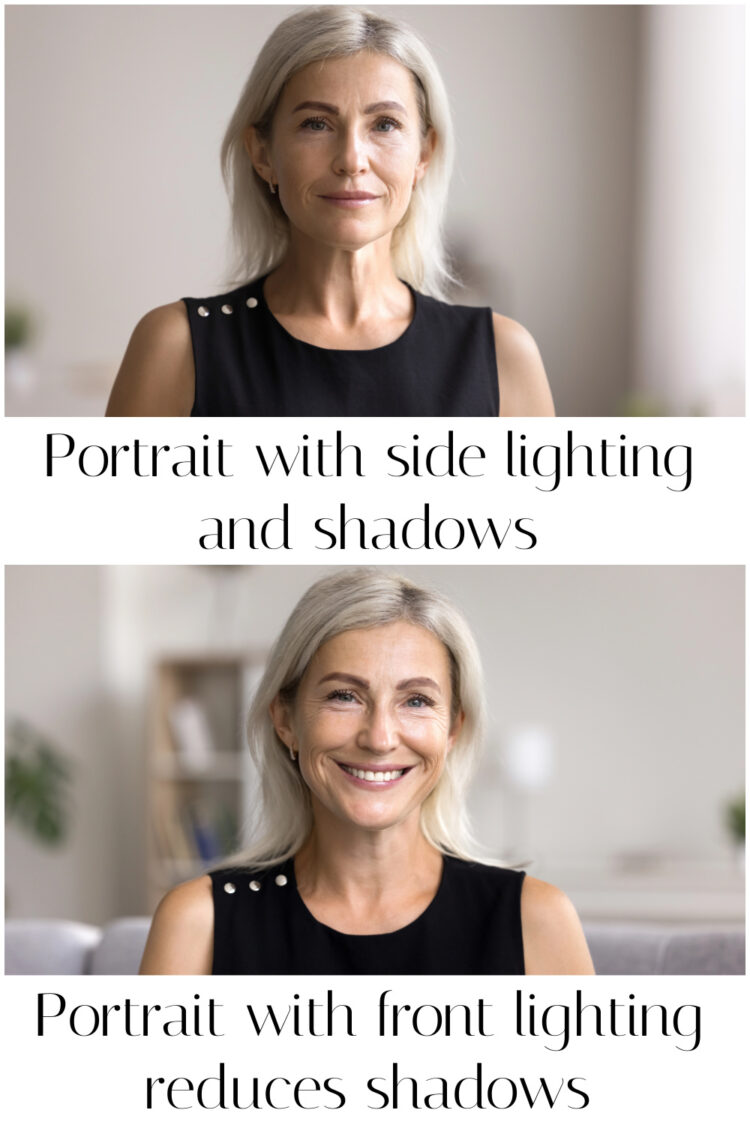
Tip 1: Find Your Light (and Ditch the Flash)
Lighting is the single biggest factor in how a photo turns out, and it's also the thing most of us have the most control over — even at a party or event.
The golden rule: light should hit your face from the front, not from above or behind you. Overhead lighting, like most indoor ceiling lights and bare midday sun, throws harsh shadows under your eyes, nose, and chin. That's what's making you look tired, not you.
Natural window light is your best friend. If you're indoors, find a window and face it. You don't need to be pressed up against it — a few feet away is fine. The soft, diffused light it provides is genuinely flattering for skin of all tones, and it doesn't flatten features the way flash does.
Outdoors: avoid shooting in direct midday sun. Open shade: under a tree, an awning, on the shady side of a building gives you that same soft, even light without the squinting.
If you tend to get puffy eyes in the morning (hi, same), wait for afternoon light for selfies. And if someone pulls out a flash at a gathering, step slightly to the side rather than standing dead center: you'll catch the light more evenly.
STYLIST's NOTE:
Overcast days are secretly the best days for outdoor photos. Cloud cover acts like a giant diffuser, and skin just looks luminous. Never skip a photo op because it's cloudy.
Tip 2: Your Angle Is Everything
Nobody, and I mean nobody, looks their best straight-on in a photo. Not supermodels, not celebrities, not your most photogenic friend. Facing directly into the camera flattens your features, widens your silhouette, and removes all the dimension that makes a face interesting.
The fix is simple: turn your body about 45 degrees. One shoulder toward the camera, weight on your back foot. That's it. This one shift creates shape, narrows your silhouette, and gives your waist definition with zero effort.
For your face: most people have one side that photographs better than the other. Take a few test selfies from both sides and figure out which one you prefer, then use it consistently. A slight three-quarter angle (turned, not profile) is almost universally more flattering than straight-on.
Camera height matters too. A camera held at eye level or slightly above is generally flattering. Below eye level? Not so much, it emphasizes your chin and shortens your neck. This is why the phone-held-high selfie exists, and why it works.
Tip 3: What You Wear Matters More Than You Think
As a former personal stylist, this is the tip I care about most because it's the one most photo advice completely ignores.
The camera sees fabric, color, and fit differently than your eye does in a mirror. Things that look perfectly fine in person can read as busy, washed out, or shapeless in a photo.
Colors: Saturated, medium-toned solids are your most reliable option. Avoid very bright whites (they blow out in light) and very dark blacks on a dark background (you disappear). Bright neons create harsh contrast. Jewel tones like navy, emerald, burgundy, and cobalt are reliable because they're rich without being overwhelming.
Prints: Small, tight patterns (like tiny houndstooth or fine stripes) can vibrate or blur on camera. Medium to large-scale prints generally read better. Busy all-over prints can make you look larger on camera than you are in person.
Fit: The camera exaggerates both too-tight and too-loose. Something that feels comfortably fitted in person often photographs the best. Clothes that pull, bunch, or gap (even slightly) will catch the light and be visible.
One thing I always tell clients before a shoot: wear something you've worn before and felt great in. This is not the time to debut a new purchase you're unsure about. Confidence in what you're wearing shows up on camera.
STYLIST'S NOTE:
When looking for jewel tones and beautifully colored blouses and knitwear in a beautiful range of sizes, I recommend checking out:
- J. Crew: Great selection of colors in the fall and winter, especially in cashmere, which photographs nicely
- Talbots: Offering petites, plus, and plus size petite, Talbots carries high-quality refined knit tops and sweaters
- Lands' End: A sleeper hit, Lands' End offers Misses, Petite, Plus, and Tall in elevated tees and knits, and well as sweaters in natural fibers like cotton and cashmere
Tip 4: Posture and Body Placement (The Secret Most People Skip)
Posture in photos is talked about a lot: “stand tall, shoulders back,” but there are a few specific mechanics that make a real difference that nobody explains properly.
The chin trick: Push your forehead slightly forward and bring your chin slightly down. It sounds bizarre, and it feels bizarre the first time you do it. But it creates jaw definition, minimizes any double-chin effect, and lengthens your neck on camera. Practice in a mirror before you try it live.
Arms away from your body: When you press your arms flat against your sides (which is what everyone instinctively does when someone points a camera at them) your arm gets compressed and reads wider on camera. Create a small gap. Put one hand on your hip, hold a bag, hold a drink, or simply let your arms hang with a slight bend and an inch of space between them and your torso. It makes a significant difference.
Weight on one foot: Shift your weight to your back foot. This naturally creates a slight hip angle, relaxes your body, and gives the photo some life. Standing with equal weight on both feet tends to look stiff and flat.
Lean slightly toward the camera: A subtle lean from the waist forward is an instant body-slimmer and creates a sense of engagement. Not a dramatic bend — just a slight shift of your upper body toward the lens.
Tip 5: Your Face — Jaw, Chin, and That Smile
There are entire books written about smiling for photos, and most of the advice boils down to the same unhelpful instruction: ‘just relax and be natural.' Cool, thanks.
Here's what actually works:
- The tongue-on-roof trick: Press the tip of your tongue gently to the roof of your mouth just behind your front teeth before you smile. It engages your jaw and neck subtly, and produces a more natural, less strained expression. Sounds odd. Works every time.
- Smile with your eyes: Before the photo, think of something that genuinely amuses you. Not a fake scenario; an actual memory or thought. The difference between a real smile reaching your eyes and a ‘say cheese' smile is visible from thirty feet away.
- Take a breath before the shot: Exhale slowly and then smile. Your face relaxes, your shoulders drop, and the tension that builds up from waiting for ‘the shot' disappears.
- Find your smile: Some people look better with teeth, some without. Neither is wrong. If you're not sure, take a few test photos both ways and compare. Commit to what you like and stop second-guessing it mid-photo.
One more thing: if you get a photo back and you hate it, try flipping it horizontally before you delete it. We're used to seeing ourselves in mirrors which show a reversed image, so our own faces can look ‘off' to us in photos even when they look completely normal to everyone else.
Tip 6: Stop Posing and Start Moving
This is the tip that unlocks all the others.
When we ‘pose,' we freeze. And frozen people look stiff, self-conscious, and nothing like themselves. The best photos almost always happen in the moments between the official poses: when you've exhaled, when you just said something funny, when you're adjusting your jacket or mid-laugh.
Tell whoever is photographing you to keep shooting. Walk slowly. Turn around and walk back. Laugh at something. Look away and then back at the camera. Touch your hair. Adjust your bag. These small movements produce photos that look like you actually inhabit your own body, which is the whole goal.
For selfies: the same principle applies. Take ten photos instead of one. Move your head slightly between each shot: tilt, turn, look up, look slightly off to the side. The odds of getting a good one out of ten are infinitely better than getting a good one from a single stiff attempt.
And honestly? The more photos you take, the less precious each one becomes, and the more relaxed you get. The relaxed version is almost always the best version.
STYLIST'S NOTE:
Made popular by TikTok and Instagram reels, if you rock from one leg to the other and “gallop” while the photographer takes pictures, you can end up with some of the most natural and dynamic photos. Here is a video on Instagram that shows it in action!
The Bottom Line
Looking better in photos isn't about looking different than you are. It's about learning a handful of mechanics: lighting, angle, posture, and movement that help the camera capture a more accurate version of who you actually are.
You look good. Cameras are just tools, and like any tool, they work better when you know how to use them.
If you try any of these tips and want to share what worked for you, drop it in the comments or come tell me in the Wardrobe Oxygen community. I genuinely love hearing what makes a difference for real women in real situations, not just in professional photo shoots.
Did you like what you just read?
Consider tapping here to buy me a coffee in thanks. The best gift you can give a content creator is the gift of sharing. Consider sharing this article on Facebook or Pinterest. Thank you so much for your support!

Thanks for this! I’m always afraid to post outfit picks on my blog because I always look squat and stiff, but I think this will help,
http://Www.yousaucyminx.com
Great!
Love this — I never knew about turtle neck, but it explains why I dislike so many photos of myself! Thank you – wish I’d had it on vacation last week, but I will use these tips going forward!
Now each time I get my photo taken I hear my friend Insana’s voice hollering TURTLE in my head! 🙂